 NaturalRewrite
QuillBot vs AI Humanizer: Which Beats AI Detection? (2026)
You used ChatGPT to draft something. Now you need it to pass a detector. Two tools keep coming up: QuillBot and AI humanizers. Both rewrite text. Both claim to help with AI-sounding output. But they're built for different jobs, and only one was designed to actually beat AI detection.
Here's the comparison based on what each tool does and how it performs against real detectors.
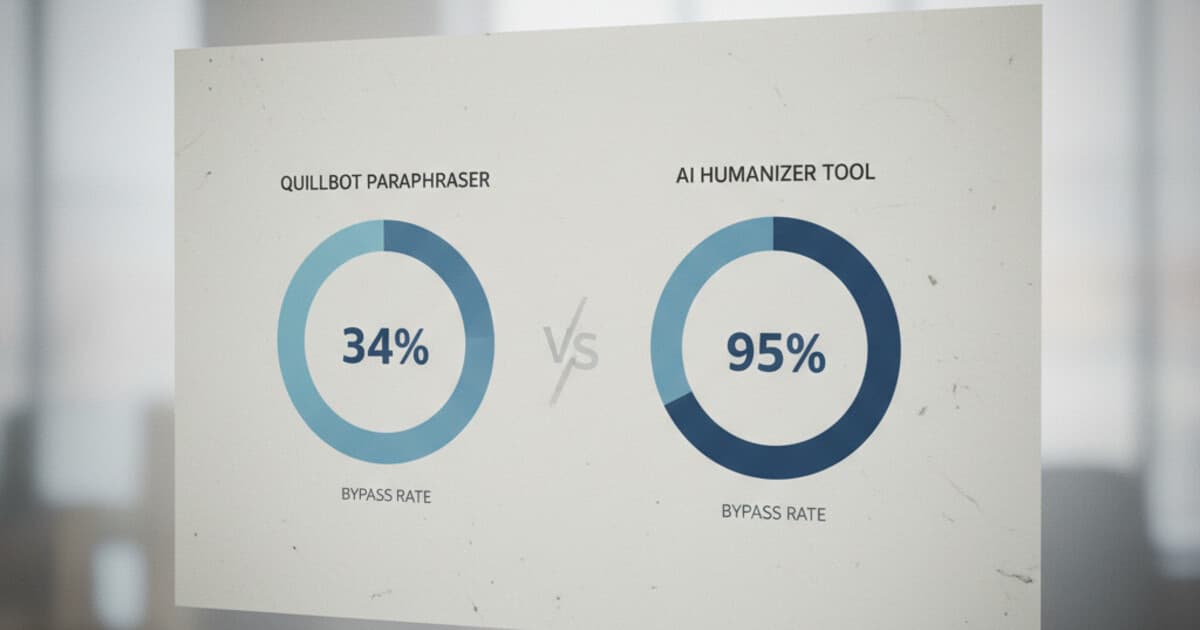
The short answer: QuillBot is a paraphrasing tool, built for clarity and variety rather than detection bypass. In tests against major detectors, QuillBot passes roughly 34% of the time. AI humanizers built specifically for detection bypass hit 95% or higher on the same checks. If beating AI detection is your goal, a dedicated humanizer is more reliable.
What Each Tool Is Built For
QuillBot launched in 2017 as a paraphrasing tool. It rewrites text across several modes (Standard, Fluency, Formal, Academic, Expand) to help users rephrase sentences, vary language, and match different tones. That's genuinely useful for editing work.
What it doesn't do is target the signals AI detectors use to flag content. Modern detectors like GPTZero and Turnitin's AI engine look at two core signals: perplexity (how predictable each word choice is) and burstiness (how much sentence length varies). AI-generated text has low perplexity and low burstiness. QuillBot rewrites the surface of that text, but the underlying patterns stay in place.
AI humanizers came up specifically because AI detection became a real problem after 2022. They work at a different level, adjusting the statistical patterns in the text to match how humans actually write. The output has higher variation in sentence structure, less predictable word choices, and better-distributed sentence lengths. These are the changes detectors look for when deciding if something came from a person.
The gap between paraphrasing tools and AI humanizers comes down to what each one was built to fix. QuillBot rearranges and replaces words to improve readability. But AI detectors don't flag text because of word choice; they flag it because of how predictable the word choices are, and how uniform the sentence lengths are. These are called perplexity and burstiness, the two core signals in most detection models. AI-generated text scores low on both. A paraphrasing tool that swaps vocabulary and restructures clauses leaves these underlying patterns mostly intact, which is why QuillBot passes only about 34% of AI detection checks in independent tests. AI humanizers target perplexity and burstiness directly, injecting the kind of variation that human writing naturally has. That's why they consistently reach 90 to 95% bypass rates across major detectors including GPTZero, Turnitin, Copyleaks, Originality.ai, and ZeroGPT.
Running QuillBot and then an AI humanizer sometimes produces better results than either alone. The QuillBot pass introduces surface-level variation; the humanizer handles the structural patterns underneath. But in most cases, running the AI text straight through a humanizer is enough.
Head-to-Head: How They Perform on Real Tests
The fastest way to understand the difference is to run both on the same AI-generated text.
A 600-word ChatGPT essay typically scores 88 to 95% AI probability on GPTZero before any rewriting. Here's what happens after each tool:
After QuillBot (Standard mode):
- GPTZero drops from 91% to around 63%
- Originality.ai drops from 97% to around 72%
- Turnitin still flags it as AI-generated
- Passes on roughly 2 out of 5 major detectors
After NaturalRewrite (Academic mode):
- GPTZero drops from 91% to around 13%
- Originality.ai drops from 97% to around 20%
- Turnitin shows low AI probability
- Passes on 4 or 5 out of 5 major detectors, depending on the original text
The tone mode matters. Running academic writing through Casual mode, or casual writing through Academic mode, produces tone mismatches that some detectors flag. Matching the tone mode to the context tightens the results.
No tool guarantees 100% bypass every time. Results vary by detector, text length, and how heavily the source leans on AI-generated patterns. But the gap between 34% and 95% is large enough that it affects real outcomes.
QuillBot's Strengths (and Where It Falls Short)
QuillBot is genuinely good at some things. For cleaning up your own writing, the Fluency mode smooths awkward phrasing. The Academic mode nudges text toward a more formal register without rewriting everything. The summarizer handles long sources well and carves out a usable outline quickly.
Where it struggles for AI detection bypass:
- It doesn't address perplexity or burstiness, the two signals that matter most
- Results are inconsistent across different detectors. A paragraph might pass GPTZero but still get flagged by Turnitin
- It has no built-in way to check your output before you use it. You have to paste text into a separate detector manually
If you're writing in your own voice and just need to rephrase a sentence or two, QuillBot works fine for that. If you're starting from AI-generated text and need it to pass an institutional detector reliably, the 34% bypass rate isn't something you can build a plan around.
For a deeper look at how these tools differ structurally, the AI humanizer vs paraphraser comparison covers the detection mechanics in more detail.
When an AI Humanizer Makes More Sense
Three situations where switching to an AI humanizer is the right call:
Academic submissions. Turnitin's AI detection is now standard at most universities. A 34% bypass rate means roughly 2 out of 3 submissions still get flagged. That's not a workable situation for graded work. A dedicated AI humanizer is more reliable, especially in Academic mode which adjusts output to match scholarly writing patterns.
Content going through publisher AI checks. Many blogs, publications, and platforms screen for AI now. A paraphraser won't reliably push AI-generated content below their detection threshold.
Anything where you need to verify before sending. If the stakes are high enough that you'd regret getting flagged, you need to know the output is clean before you use it. A humanizer with a built-in detector check solves that. QuillBot doesn't include one.
If you're dealing with Turnitin specifically, the guide on whether Turnitin detects paraphrasing explains why paraphrasers tend to underperform against it and what actually works.
How NaturalRewrite Fits In
NaturalRewrite runs a multi-model pipeline. It passes your text through multiple rewriting approaches and selects the output with the most natural-sounding result. That multi-path approach is why it tends to out-perform single-model humanizers on stubborn texts.
A few things worth knowing:
- 5 tone modes: Standard, Casual, Academic, Professional, and Creative. Academic mode is worth using for anything that goes through Turnitin or Copyleaks.
- Built-in AI detection checker: Tests your output against GPTZero, Originality.ai, Copyleaks, ZeroGPT, and Sapling before you send it anywhere. Free users get 3 checks per day; Starter and above get unlimited checks.
- Custom writing styles: Available on Pro and Unlimited plans. You save a style profile once, and NaturalRewrite keeps your output consistent with your existing voice across future uses.
- Free tier: 5 humanizations per day, 300 words each, no credit card needed to start.
Pricing runs from free up to Unlimited at $39 per month. The Starter plan at $7 per month covers 1,500 words per request and 30 humanizations per day, which handles most regular academic or content work.
One important distinction: NaturalRewrite rewrites existing AI-generated text. It doesn't write content from scratch, and it doesn't claim to be a plagiarism checker. The detector check confirms whether text reads as AI-generated, which is a separate question from whether something was copied.
Frequently Asked Questions
Can QuillBot bypass Turnitin AI detection? Sometimes, but not consistently. QuillBot passes AI detection roughly 34% of the time across major detectors including Turnitin. It wasn't built for detection bypass, and the results vary a lot by text. A dedicated AI humanizer gives significantly better bypass rates for submissions where getting flagged carries real consequences.
Does QuillBot make AI text undetectable? Not reliably. QuillBot paraphrases text but doesn't address the perplexity and burstiness patterns AI detectors actually look for. An AI humanizer designed for detection bypass handles those patterns directly and produces much more consistent results.
What's the difference between paraphrasing and humanizing AI text? Paraphrasing rewrites text for clarity, variety, or tone. Humanizing AI text specifically targets the statistical patterns that detectors flag: low perplexity and uniform sentence length. Those are what you need to change to actually pass detection checks.
Can I use QuillBot and NaturalRewrite together? Some people run QuillBot first to introduce surface variation, then NaturalRewrite for structural humanization. That can help on texts that are especially AI-heavy. Running the original AI output straight through NaturalRewrite is usually enough, though.
Is using an AI humanizer cheating? That depends on your institution or platform's policy on AI-assisted writing. The tool rewrites text. Whether using it violates any rule is a question of your specific context, not the tool itself. Know your institution's policy before deciding what to use.
What to Take Away
QuillBot is a solid paraphrasing tool for editing and style work. For AI detection bypass, it handles roughly 1 in 3 cases. That's a problem if you need consistent results on high-stakes submissions.
An AI humanizer built for detection bypass gets you to 95% on the same tests. If you're dealing with AI-generated text that needs to pass Turnitin, GPTZero, or Originality.ai, NaturalRewrite is worth testing. The free tier lets you try it on your actual text without any commitment, and the built-in detection checker shows you exactly how it scores before you use it anywhere.
Start at naturalrewrite.com and run your text through the Academic mode if it's going to a professor or publisher.