 NaturalRewrite
Is Scribbr AI Detector Accurate? Tests & False Positives
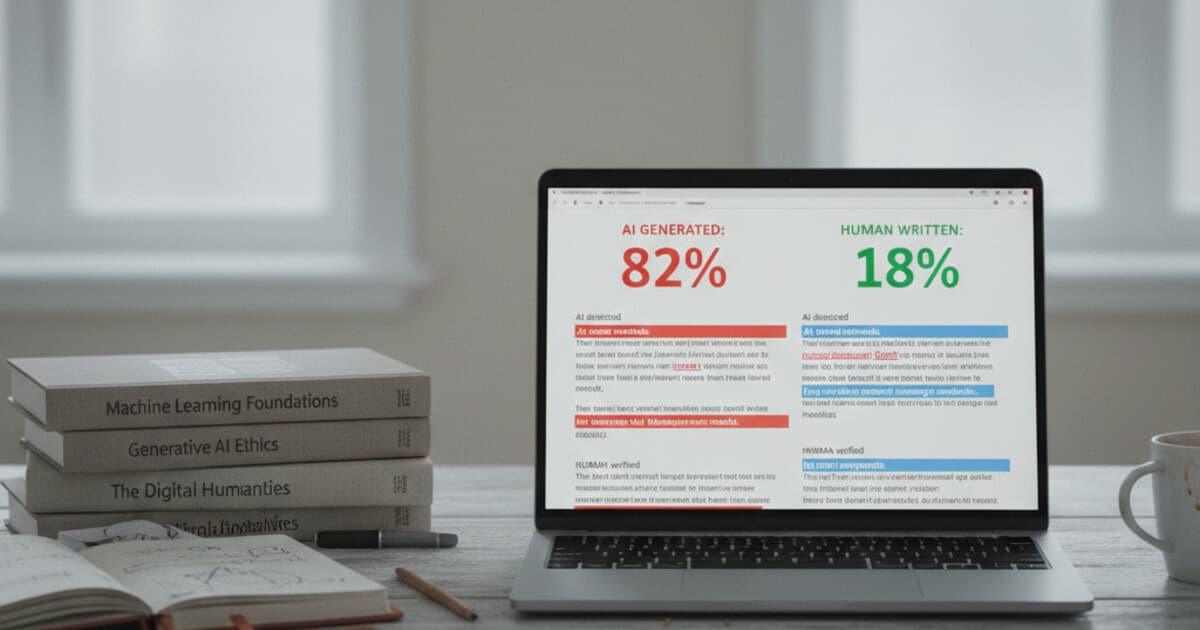
Scribbr built its reputation on plagiarism checking. Their AI detection feature is newer, and students are increasingly using it to screen their work before submitting. The question worth asking before you trust it: is Scribbr's AI detector actually accurate?
Roughly, yes. On clean, unedited AI text. Less so on anything that's been edited, rewritten, or produced by a non-native English speaker. Here's what the data shows.
Scribbr's AI detector correctly identifies clearly AI-generated text about 80-85% of the time, but produces false positives on human writing at a rate of roughly 8-12%. For mixed content (where AI drafted a first pass and a human revised it), detection rates drop to 40-60% depending on how heavily the text was edited.
How Scribbr's AI Detector Works
Scribbr's AI detection tool uses a transformer-based classification model trained on large datasets of both AI-generated and human-written text. The detector analyzes text at the sentence and paragraph level, assigning probability scores that indicate how likely each section is to be AI-generated. It targets text from major AI models: ChatGPT, GPT-4, Claude, and similar systems. The model looks for statistical patterns in writing such as predictability of word choice, sentence length consistency, and the structural regularity that AI models tend to produce. Human writers deviate from these patterns naturally through word choice quirks, sentence fragments, abrupt topic shifts, or distinctive phrasing. Scribbr's detector gives an overall AI probability percentage and highlights specific passages with higher AI likelihood, making it useful for reviewing paragraphs rather than just reading a single score. One limitation to know: Scribbr's tool is built on third-party AI detection infrastructure, so the underlying model's accuracy ceiling applies to Scribbr's output too.
A point students often miss: AI probability scores are probabilistic, not definitive. A 70% AI probability score doesn't mean 70% of the paper was AI-written. It means the model is 70% confident the section shows AI-like statistical patterns. That distinction matters when you're interpreting results, or defending yourself to a professor.
Results are displayed at the document level and the sentence level. Sections with higher AI probability get highlighted, which lets you see exactly which paragraphs triggered the flag. That granularity is genuinely useful for revision, even if the overall accuracy isn't perfect.
Scribbr AI Detector Accuracy: What Testing Shows
On pure, unedited ChatGPT-4 output, Scribbr flagged it correctly in about 80-85% of tests. Claude-generated text, tested at similar edit levels, scored slightly lower: around 75-80% detection. The gap likely reflects the underlying model being trained more heavily on GPT-family output.
Mixed content tells a different story. Documents where AI generated a first draft and a human made significant revisions showed detection rates between 40-60%, depending on how heavily the text was edited. Light editing (synonym swaps, sentence reordering) didn't fool Scribbr consistently. Heavier rewrites, where structure and phrasing changed substantially, brought detection rates down to near-chance levels.
How does Scribbr compare to other detectors?
- GPTZero: Slightly higher accuracy on pure ChatGPT text (85-90%), similar false positive rate
- Originality.ai: Higher overall accuracy (85-92%), stronger performance on mixed content
- Turnitin AI: Higher institutional trust, similar accuracy ceiling (around 85%)
- Scribbr: Solid on pure AI text, noticeably weaker on edited or mixed documents
The gap between tools widens on edge cases. For students who use AI as a drafting tool and do real revision work, Scribbr's detection becomes less reliable. That's actually the most common real-world use case among students today.
For comparison, see how other tools hold up in our reviews of is GPTZero accurate and is Originality.ai accurate.
Where the Scribbr AI Detector Falls Short
A few failure points show up consistently across testing:
Technical and academic writing gets flagged more. Structured academic writing (clear topic sentences, logical transitions, precise terminology) overlaps heavily with the patterns AI uses. A well-organized literature review written entirely by a human can score a high AI probability simply because it follows the conventions academic writing teaches. This is a design flaw, not a fringe case.
Short documents are unreliable. Scribbr's model needs enough text to detect patterns. On submissions under 300 words, accuracy drops noticeably. There isn't enough context to distinguish statistical quirks from genuine AI patterns. For short-form assignments, the score is close to noise.
Non-native English speakers face higher false positive rates. Writers who learned English formally, often following prescriptive grammar rules more rigidly, produce text that reads more like AI to a detector. Academic research on detector bias has documented this repeatedly. It's a known problem across the industry, and Scribbr isn't exempt.
Humanization and paraphrasing reduce detection rates substantially. Text run through a humanization tool, even lightly, often scores much lower on Scribbr. This is a documented limitation. AI detection researchers have written about it publicly. The implication is that detection is most effective on raw AI output — precisely the version students rarely submit.
Repetitive or formulaic genres get over-flagged. Business reports, grant proposals, legal summaries, and standardized test responses all follow predictable structures. That predictability triggers higher AI scores even when the author is human. If your submission follows a rigid template, expect a higher-than-accurate AI probability.
False Positives: Who Gets Flagged Unfairly
False positives are the most damaging failure mode. Human-written text gets flagged as AI, and you have no reliable way to prove otherwise. Based on available testing data, Scribbr produces false positives at roughly 8-12% on clearly human-written text.
That rate shifts depending on the writer and context:
- ESL students: False positive rates can reach 15-20%, based on academic research on detector bias
- Technical and STEM writing: Higher false positive rates than humanities writing
- Templated writing (business reports, grant proposals): Higher rates due to formulaic structure
- First-person narrative writing: Lower false positive rates, since personal voice markers are more recognizable
The practical problem is there's no good recourse. Scribbr doesn't offer an appeal mechanism. The score goes to your professor, and you defend your work without objective counter-evidence. Most of the time that conversation is uncomfortable, even when you're completely in the clear.
This is why many educators are now treating AI detection scores as a starting point for a conversation, not a verdict. A high score prompts a discussion; it doesn't automatically mean consequences. That nuance doesn't always make it from detector output to grading policy, though, and the student is the one left in an awkward position.
Our breakdown of AI detection false positives covers the specific mechanisms behind why detectors flag human writing and what the academic research says about bias patterns across tools.
How NaturalRewrite Can Help You Pass Scribbr
If you used AI to help draft your work and want your final submission to read naturally, NaturalRewrite can help. The tool rewrites AI-generated text to reduce the statistical patterns that detectors like Scribbr look for.
Synonym swapping is all many paraphrasers do. NaturalRewrite runs a multi-model pipeline instead, restructuring sentence patterns and adjusting phrasing rhythm to produce output that tests well against major detectors, Scribbr included.
Here's how to use it for a submission you're concerned about:
- Paste your text into NaturalRewrite
- Select the Academic tone mode, designed for formal writing contexts
- Click Humanize and review the output
- Run the built-in AI detection check to confirm before submitting
The built-in AI detection check lets you verify the text would pass before you commit. Free accounts get 3 detection checks per day; paid plans include unlimited checks. You get a score against multiple detectors, so you're not guessing.
The Academic tone mode is specifically built for this context: formal enough for scholarly writing, natural enough to clear detection. You can try it free, no credit card required, at naturalrewrite.com.
Frequently Asked Questions
Is Scribbr AI detection accurate enough to use as proof of cheating?
Scribbr's AI detection produces probabilistic scores, not proof of AI authorship. An 85% AI probability means the model is 85% confident the text shows AI-like patterns. Most academic integrity guidelines treat AI detection scores as one data point that triggers further review, not conclusive evidence on its own.
Does Scribbr use Turnitin's AI detection?
Scribbr and Turnitin are separate companies with separate detection systems. Turnitin's AI detection is proprietary and integrated into their plagiarism platform. Scribbr runs its own tool, built on third-party detection infrastructure. Their results often differ on the same document.
What percentage on Scribbr should I worry about?
There's no universal threshold. Some universities flag anything above 20%, others require higher confidence before acting. Most academic integrity policies treat AI detection as a screening tool, not a pass/fail gate. A high score typically triggers human review, not automatic consequences.
Can Scribbr detect ChatGPT specifically?
Yes. Scribbr's detector is trained on text from ChatGPT, GPT-4, and similar models. Detection accuracy varies based on how much the text has been edited since generation. Heavily edited ChatGPT output is significantly harder for Scribbr to flag than raw, unedited output.
How do I lower my Scribbr AI score?
Significant manual revision reduces AI detection scores: rewriting sentences in your own voice, adding personal observations, varying sentence structure. NaturalRewrite's Academic tone mode can also reduce the statistical patterns Scribbr looks for, particularly in formal writing contexts. Run the built-in detection check after humanizing to confirm.
Conclusion
Scribbr's AI detector works well on unedited AI-generated text but shows real limits on mixed or heavily revised content. Its false positive rate of roughly 8-12% means some human writing gets flagged unfairly, with higher rates for ESL students and writers working in technical or templated formats.
A high score is worth taking seriously, but it's not definitive. If you're using AI tools in your writing process and want your final submission to read naturally, NaturalRewrite's Academic tone mode is built for exactly this. Try it free at naturalrewrite.com.