 NaturalRewrite
Is Copyleaks Accurate? Tests, Limits & False Positives
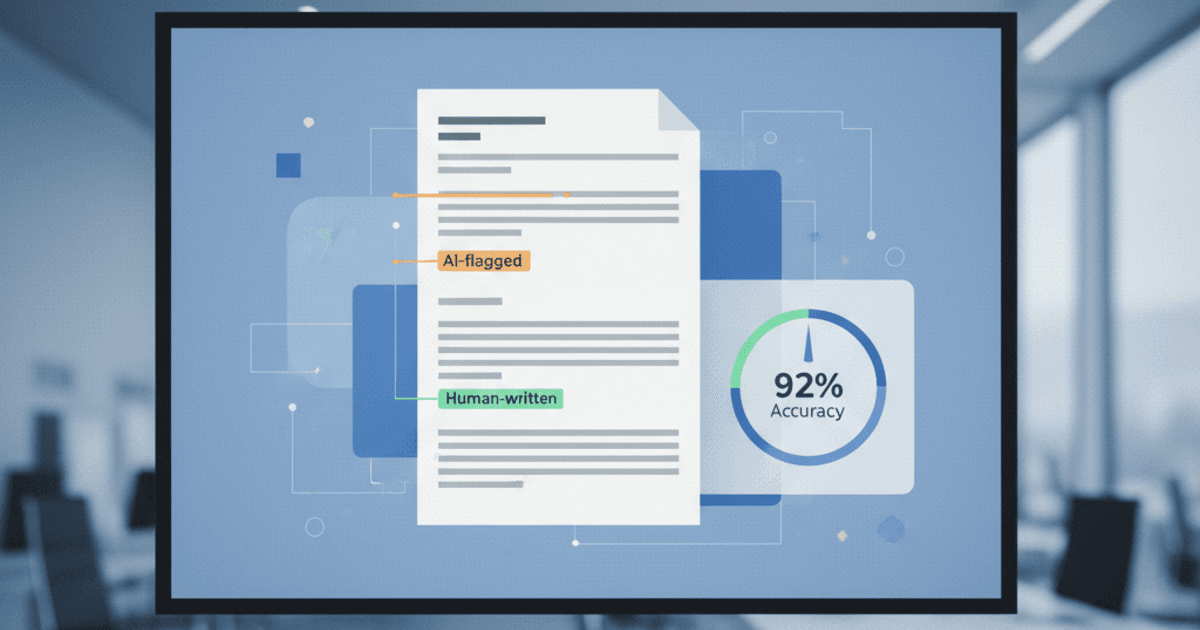
Copyleaks started as a plagiarism checker for universities. When AI writing tools took off in 2023, it wired an AI content detector into the same platform.
Now institutions use it to scan student submissions alongside plagiarism checks. Writers run their own content through it before publishing. The question is how much weight you should actually put on those results.
Copyleaks AI detection is reasonably accurate for unedited AI text, but its real-world performance falls short of its marketing numbers. The tool claims 99.1% accuracy in internal benchmarks, but false positive rates in practice run between 5% and 15% for human-written content. Academic prose and text from non-native speakers trigger false flags more often.
What Is Copyleaks and How Does Its AI Detection Work?
Copyleaks launched its AI Content Detector in early 2023, building it onto an existing plagiarism platform that schools had trusted for years.
The detection analyzes statistical patterns in text. AI models produce writing with predictable word distributions and sentence structures. Copyleaks trained classifiers on large datasets of AI-generated and human-written samples to spot those patterns.
The tool works at the sentence level, not just the document level. You won't get just an overall score. You'll get a color-coded breakdown showing which specific sentences triggered the detector.
It covers content from ChatGPT (GPT-4, GPT-4o), Claude, Gemini, Llama, and other major models. It also flags "AI-human mixed content," meaning text that started as AI output but got edited afterward.
Copyleaks markets its AI detector with a claimed 99.1% accuracy rate from internal benchmarks that used clean, unmodified AI text versus clearly human-written content. In those controlled conditions, the results look strong. Real-world accuracy tells a different story. Independent researchers and users consistently report false positive rates between 5% and 15% for human-written text, particularly when that text is technical, academic in tone, or written by non-native English speakers. The sentence-level analysis Copyleaks uses can flag human sentences that happen to match common AI phrasing patterns. A student writing formal academic prose might trigger the same signals as GPT-4o output. Accuracy also degrades when AI text has been lightly edited: Copyleaks struggles to reliably identify paraphrased AI content, sometimes catching it, sometimes missing it entirely. For institutions using Copyleaks to make academic integrity decisions, this variability is worth understanding before acting on a detection result.
How Accurate Is Copyleaks at Detecting AI Writing?
The 99.1% accuracy figure comes from Copyleaks' own testing. They fed the detector clearly AI-generated samples and clearly human-written ones. Under those clean, controlled conditions, the numbers look impressive.
Real student submissions don't look like clean lab samples. Writers edit. They paraphrase. They blend AI drafts with their own sentences. That's where the accuracy gaps open up.
Some patterns researchers and users have documented:
- Formal academic writing styles can match AI patterns closely, triggering false flags
- ESL writers get flagged at higher rates than native English speakers
- Lightly paraphrased AI content sometimes slips through undetected
- Heavily edited AI text becomes increasingly hard for the tool to catch
Copyleaks publicly reports a false positive rate under 2% in controlled tests. Real-world numbers run higher, probably 5-10% for most content types. For a tool that universities use to make academic integrity decisions, that gap matters.
Copyleaks False Positives: When It Gets It Wrong
False positives are the biggest practical problem with any AI detector, and Copyleaks is no different.
A false positive means the tool flags human-written text as AI-generated. For a student, that can mean an integrity accusation. For a writer, it means a rejected submission.
Several types of writing trigger false positives more often than others:
Formal academic writing. The structured, citation-heavy style of academic papers can look statistically similar to AI output. Short sentences. Precise word choices. Predictable paragraph structure. These are hallmarks of good academic writing, and also hallmarks of GPT-4o output.
Technical documentation. Step-by-step instructions, numbered lists, and consistent terminology set off detectors more often than conversational prose does.
Non-native English speakers. Writers who haven't fully internalized the variety and idiosyncrasy of native English prose sometimes produce cleaner, more uniform text. That uniformity reads as AI to the classifiers.
If Copyleaks flagged your work and you know you wrote it yourself, check our breakdown of AI detection false positives for a detailed look at why this happens across detectors.
The fix for legitimate false positives is rewriting the flagged sections in a more varied style. Add contractions. Vary sentence length. Include specific details or personal examples. These changes push the statistical signature toward human-written territory.
How Copyleaks Compares to Other AI Detectors
Copyleaks sits in the middle of the pack for AI detection accuracy.
GPTZero tends to run more conservative: fewer false positives, but it also misses more AI-generated content. Originality.AI goes the other direction, with more aggressive detection and a higher false positive rate for borderline cases. ZeroGPT has a reputation for inconsistency and is generally considered less reliable than the others.
We ran both ZeroGPT and Originality.AI through similar accuracy tests. Our ZeroGPT accuracy breakdown and Originality.AI accuracy review cover what those tools miss and where they overcorrect.
Copyleaks' main advantage is integration. If your institution already uses it for plagiarism checking, the AI detection feature comes baked into the same dashboard. You don't need to submit content to a separate tool.
The main disadvantage is that the marketing claims set expectations the real-world tool can't consistently meet in messy conditions.
Does Copyleaks Detect Paraphrased or Humanized AI Text?
This is the question most students and writers actually care about.
Copyleaks catches some paraphrased AI content but misses a significant portion, especially text that's been processed by a dedicated AI humanizer.
Simple synonym swapping doesn't reliably fool Copyleaks. The tool looks at deeper linguistic patterns, not just word choice. If the sentence structure and rhythm still match AI patterns, swapping in synonyms won't move the score much.
Humanization tools that rewire sentence structure, inject natural variation, and adjust the underlying rhythm of the text are more effective. The goal is shifting the statistical signature of the writing, not just substituting vocabulary.
If you want to know where your text stands before submitting, running it through a tool with a built-in detection checker gives you a concrete score to work with. Copyleaks is one data point. Checking against multiple detectors gives you a more complete picture.
For a detailed walkthrough of what specifically works against Copyleaks detection, see our guide on how to bypass Copyleaks.
How NaturalRewrite Handles Copyleaks
NaturalRewrite was built with detectors like Copyleaks in mind.
The humanization process goes deeper than paraphrasing. It strips back sentence-level patterns and rebuilds the text's rhythm to move away from AI statistical signatures. You paste your AI-generated content, pick a tone mode that fits the context (Academic for papers, Professional for work submissions, Casual for blog posts), and click humanize.
The built-in AI detection checker then runs your output against multiple detectors so you can see where things stand before it matters. Free accounts get 3 checks per day. Starter plans and above get unlimited checks.
Word limits per request scale with your plan: 300 words on Free, 1,500 on Starter, 3,000 on Pro, and 5,000 on Unlimited. For longer papers, you work through it in sections.
Paste, humanize, check, adjust if needed, submit.
Frequently Asked Questions
What is Copyleaks' accuracy rate for AI detection?
Copyleaks reports 99.1% accuracy from internal benchmarks using clean, unedited AI samples versus human-written text. Real-world accuracy is lower. False positive rates in practice run between 5% and 15% for human-written content, particularly academic writing and text from non-native English speakers.
Can Copyleaks detect ChatGPT text?
Yes. Copyleaks detects content from ChatGPT (GPT-3.5, GPT-4, GPT-4o), Claude, Gemini, Llama, and other major models. Accuracy drops for text that's been edited or paraphrased after generation.
Does Copyleaks produce false positives?
Yes. Copyleaks flags some human-written text as AI-generated. Academic writing styles, technical documentation, and writing from non-native English speakers all trigger false positives at higher rates. This is a known limitation across all current AI detectors.
How does Copyleaks compare to GPTZero?
GPTZero is more conservative: fewer false positives but more AI content slips through. Copyleaks integrates plagiarism and AI detection in one platform, which matters if your institution already uses it. Neither tool is definitive on its own.
Can you pass Copyleaks AI detection?
AI text can pass Copyleaks detection if it's been restructured to change its underlying statistical patterns. Synonym swapping usually isn't enough. Tools that rewire sentence structure and inject natural variation are more effective than surface-level paraphrasers.
Wrapping Up
Copyleaks AI detection is useful but not infallible. The 99.1% accuracy claim reflects controlled lab conditions, not the messier reality of edited AI drafts or human writers who happen to write in formal, structured prose.
If you've been flagged and you know you wrote the content yourself, the AI detection false positives guide covers your next steps. If you're working with AI-assisted content and want to verify before submitting, NaturalRewrite lets you check against multiple detectors so you know where you stand.