 NaturalRewrite
How to Bypass Winston AI Detector in 2026
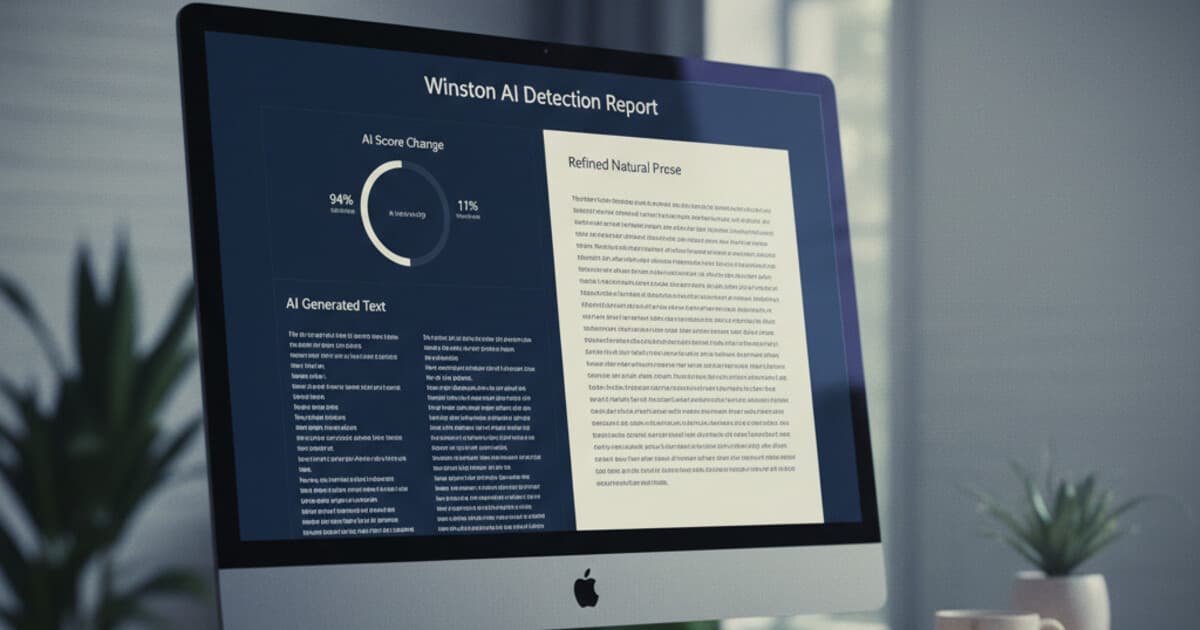
Winston AI is one of the more aggressive detectors used by schools, publishers, and content platforms. It scans text for statistical patterns tied to AI writing and returns a probability score from 0 to 100. Scores above 50% get flagged. Above 80% and most professors take action.
Getting flagged after you've already edited heavily is frustrating. It happens. Winston throws false positives on ESL writers, technical content, and short excerpts. Whether you're dealing with a genuine false positive or need to clean up AI-drafted content before submission, these methods hold up in 2026. For a broader overview of what works across all detectors, see our guide to bypassing AI detection.
To bypass Winston AI detector, you need to change the underlying statistical patterns in your text, not just swap words. The most reliable method is using an AI humanizer that rewrites sentence structure and rhythm. Manual edits like adding personal details, restructuring sentences, and varying paragraph length also lower scores significantly. Most texts that start at 90%+ drop below 20% with a single humanization pass.
What Winston AI Actually Scans
Winston doesn't look for "AI words." It runs a probabilistic analysis across your entire document.
The detector breaks text into segments and scores each one separately. It measures perplexity (how predictable each word choice is given the surrounding context), burstiness (whether sentence lengths vary or stay uniformly mid-size), and vocabulary entropy (whether word choice is diverse or suspiciously consistent).
Text that reads like the statistical average of millions of training examples scores high. Human writing takes unexpected turns and uses phrases that don't quite fit textbook definitions.
Winston markets a 99.6% accuracy claim. Independent tests on mixed-source text put the real figure closer to 84-88%. False positive rates run 6-12% on human-written academic content, and higher for ESL writers. Knowing what the detector actually measures gives you a clear target for where to focus your edits.
Where Winston AI Falls Short
Winston performs well on raw, unedited ChatGPT or Claude output. It struggles with several specific text types.
Short passages. Under 200 words, Winston doesn't have enough text to establish reliable statistical patterns. Scores on short excerpts swing widely, and the tool itself warns about this.
Specialized or technical writing. Legal, medical, and highly domain-specific content naturally falls outside the statistical distribution Winston learned from. False positive rates are noticeably higher on specialized subjects than on general academic prose. This is the same dynamic that makes AI detection false positives such a common complaint among graduate students writing literature reviews.
Heavily restructured content. Once you change 30-40% of the sentence structures (not just word choices), the patterns Winston catches start to break down. Word-level edits don't move the needle much. Structural edits do.
Mixed authorship. If you wrote half and AI drafted half, Winston often returns a score in the 40-65% range. That ambiguous middle zone doesn't clearly indicate either source, though many instructors treat anything above 50% as worth investigating.
5 Methods to Bypass Winston AI in 2026
These work. Start with the most effective and layer them as needed.
Method 1: Use an AI humanizer
This is the most reliable approach because it targets what Winston actually measures.
An AI humanizer rewrites text at the sentence level, changing structure, rhythm, and vocabulary patterns. This is different from a paraphraser, which mainly swaps synonyms while leaving the sentence skeleton intact. Paraphrasers often push Winston scores higher because the word choices become more generic. For a closer look at why that distinction matters in practice, see our AI humanizer vs paraphraser comparison.
NaturalRewrite's Academic tone mode works particularly well for academic submissions. It keeps the formal register appropriate for academic writing while stripping out the predictability patterns Winston catches. Paste your AI draft, select Academic mode, click humanize, then run the built-in detection check before submitting. Texts starting at 90%+ typically drop below 20% in one pass.
Method 2: Restructure sentences, not words
If you're editing manually, target structure rather than vocabulary.
AI text leans on Subject + Verb + Object patterns with consistently mid-length sentences. Break that rhythm by starting some sentences with prepositional phrases ("For this type of analysis,"), adding subordinate clauses mid-sentence, and deliberately mixing sentence lengths. One sentence. Then one that runs a bit longer and develops the idea before landing on the point. That variation breaks the burstiness pattern Winston looks for.
Method 3: Inject specific details
AI writing is general. It describes principles and summarizes research. It rarely uses phrases like "my professor's rubric requires" or cites a specific reading from last Tuesday.
Winston scores drop when text includes named individuals, specific dates or locations from your actual experience, and opinions backed by concrete reasoning. These details change the statistical signature in ways detectors can't easily reverse-engineer.
Method 4: Read it out loud
AI text sounds smooth when you read it silently. Read it out loud and the mechanical patterns surface fast.
Anything that sounds awkward when spoken is probably triggering the detector too. Rewrite those sentences the way you'd actually say them to another person. This catches overly formal transitions, predictable sentence endings, and phrases nobody says out loud. Method 4 alone won't clear heavily AI-generated text, but it works well alongside any of the other methods above.
Method 5: Break paragraph uniformity
AI output produces paragraphs of near-identical length: 3-4 sentences, 50-70 words each. That regularity is a signal Winston picks up.
Go through your draft and break the pattern. Combine two short paragraphs. Split a longer one into two. Start a new paragraph with a single sentence that makes one clear point. These are quick structural changes that affect your document's statistical profile and push scores down meaningfully.
How NaturalRewrite Handles Winston AI
NaturalRewrite runs a multi-model pipeline rather than simple synonym replacement, and that distinction matters for Winston specifically.
Synonym swappers change surface words but leave sentence structure intact. Winston scores those texts similarly to the original because the underlying patterns haven't changed. NaturalRewrite works at the level of sentence construction, clause order, punctuation patterns, and vocabulary together. The output reads naturally because the statistical fingerprint has genuinely changed.
A few features that help with Winston directly:
The Academic tone mode keeps content formal and scholarly while removing the predictability patterns that trigger detection flags. For students, this is the mode to use before submitting anything to a system that runs Winston checks.
The built-in AI detection checker lets you verify your score before submitting. Free accounts get 3 checks per day. Starter plans and above get unlimited checks. Run a check after humanizing to confirm you're clear before anything goes in.
The Unlimited plan supports up to 5,000 words per request, so you can process a full essay at once rather than pasting paragraph by paragraph. For shorter pieces, the free tier handles up to 300 words per request with 5 humanizations per day. The Starter plan at $7/month gives you 30 humanizations per day with a 1,500-word limit.
Frequently Asked Questions
Does Winston AI give false positives?
Yes. Winston reports false positive rates of 2-3% in their documentation, but real-world tests on academic writing show rates of 6-12%, and higher for ESL students and writers in technical fields. If you're flagged on content you actually wrote yourself, restructure your sentence patterns, add specific personal details, and verify with a detection check before resubmitting.
Is Winston AI more accurate than GPTZero or Turnitin?
Winston and GPTZero use similar perplexity-based detection approaches. Neither consistently outperforms the other across all text types. Turnitin's detector is separately trained on academic submissions and works differently. The bypass methods in this guide work well for Winston; results on GPTZero are similar. Turnitin requires a more targeted approach given its academic-specific training data.
Does Winston AI detect Claude or Gemini text?
Yes. Winston is trained on output from all major models including ChatGPT, Claude, and Gemini. It looks for patterns common to AI writing regardless of which tool generated the text. There's no model-specific bypass.
What's a passing score on Winston AI?
Winston flags text above 50% as potentially AI-generated. Many instructors treat scores above 30% as worth investigating. Aim for under 20% to have clear margin. The methods above reliably get humanized content into the 5-18% range.
Does QuillBot bypass Winston AI?
Rarely. QuillBot is a paraphraser that changes word choice while keeping sentence structure intact. Winston scans for structure and rhythm more than surface vocabulary, so paraphrasing alone rarely lowers the score reliably. In some cases it pushes the score up. A dedicated AI humanizer addresses structure and syntax together, which is what actually moves the needle on Winston.
Conclusion
Winston AI catches unedited AI text reliably. It catches lightly edited text reasonably well. It struggles with content that's been restructured at the sentence level, enriched with specific personal details, and verified with a detection check before submission.
The fastest path: paste your draft into NaturalRewrite with Academic mode, check the score after humanizing, and manually revise any flagged segments using the sentence restructuring techniques above. Most submissions clear Winston in one pass.
If you're dealing with a false positive on content you wrote yourself, the same process applies. Humanize, verify, submit. Try it free at naturalrewrite.com.