 NaturalRewrite
GPTZero vs ZeroGPT: Which AI Detector Wins in 2026?
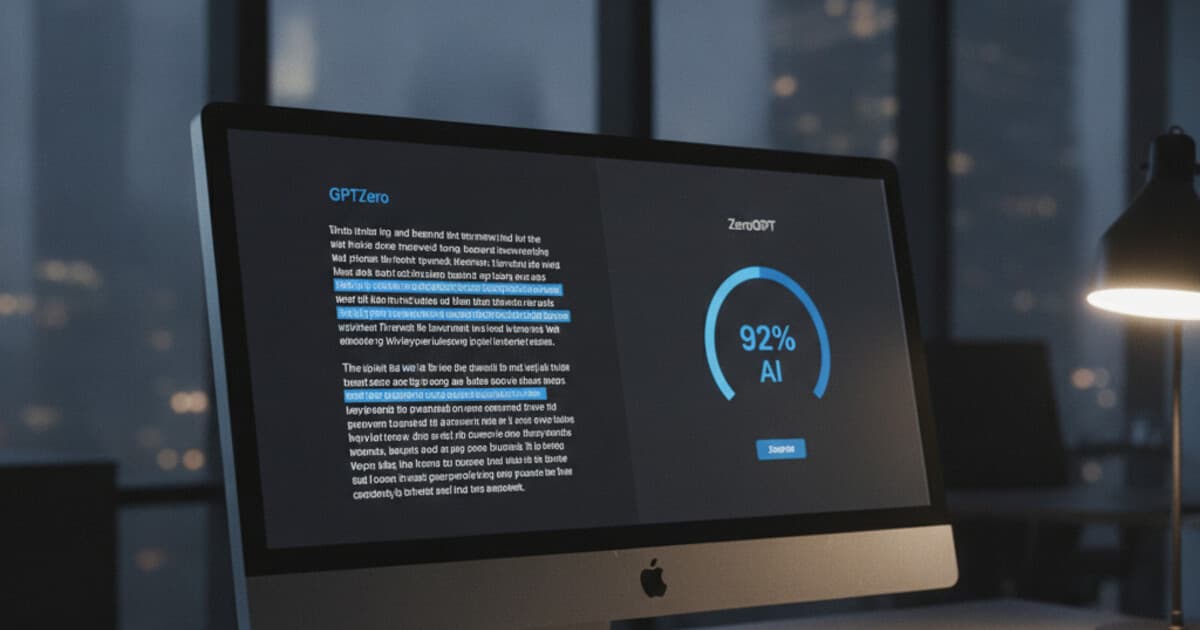
GPTZero and ZeroGPT are two separate AI detection tools that share a confusingly similar name. Students search for one and land on the other. Educators recommend one without knowing the other exists. If you've wondered whether they're the same thing, or which one you should run your text through, this comparison breaks down exactly what makes them different.
Both tools detect AI-generated writing and both offer a free version. But they come from different teams, use different detection approaches, and serve slightly different audiences. The gap between them matters when you're trying to understand your actual detection risk.
GPTZero and ZeroGPT are two separate AI detection tools. GPTZero (gptzero.me) was created by Princeton student Edward Tian in January 2023 and has become the standard in academic institutions, offering sentence-level analysis and a paid API. ZeroGPT (zerogpt.com) is a different product by an unrelated team, with a more generous free character limit and less institutional adoption.
What Is GPTZero?
GPTZero launched in January 2023, built by Edward Tian, a Princeton University computer science student at the time. The tool went viral after Tian shared it publicly, reaching millions of users within its first year. It's now used by educators, universities, and publishers worldwide.
The detection method is built around two signals: perplexity and burstiness. Perplexity measures how unpredictable the text is word by word. AI models generate low-perplexity text because they consistently favor high-probability word sequences.
Burstiness captures variation in sentence complexity. Human writers naturally vary their rhythm, mixing short punchy sentences with longer ones. AI output tends to stay flat and predictable throughout.
The free tier allows 5,000 characters per check, with a limit of 10 daily scans. Paid plans start at $10/month for educators, $16/month for premium users, and $23/month for professional use. Higher tiers unlock batch file scanning, API access, and team features.
One thing GPTZero does that most detectors don't: sentence-level highlighting. Alongside an overall AI probability score, it marks individual sentences it considers likely AI-generated. That's genuinely useful for students who wrote most of a paper themselves and want to see which specific lines got flagged.
GPTZero covers output from GPT-4, Claude, Gemini, Llama, Mistral, and other major models.
What Is ZeroGPT?
ZeroGPT (zerogpt.com) is a completely different company with no connection to GPTZero. The nearly identical name causes constant confusion, but the tools are unrelated products built by separate teams using different algorithms.
ZeroGPT markets itself as a free, no-account-required AI detector. Paste your text, click detect, and get an "AI percentage" score. The free tier allows up to 15,000 characters per check, which is 3x more than GPTZero's free tier.
The tool uses what it calls "DeepAnalyse Technology," though the technical details behind that term aren't publicly documented. The output is a percentage score (for example, "78% AI-generated") with a brief summary. There's no sentence-level breakdown in the free version.
ZeroGPT has a premium tier with additional features, but its paid offering is less prominently featured than GPTZero's tiered plans.
GPTZero vs ZeroGPT: Side-by-Side Comparison
Here's how the two tools stack up on the features that matter most:
| Feature | GPTZero | ZeroGPT | |---|---|---| | Website | gptzero.me | zerogpt.com | | Origin | Princeton (Edward Tian, Jan 2023) | Separate company | | Free character limit | 5,000 | 15,000 | | Account required (free) | No | No | | Sentence-level analysis | Yes | No (free tier) | | API access | Yes (paid) | Limited | | Institutional adoption | Widespread | Limited | | Paid plans | $10–$23/month | Available, less prominent | | Models detected | GPT-4, Claude, Gemini, Llama, more | ChatGPT and others |
GPTZero has significantly more institutional credibility. Hundreds of universities and K-12 districts have bolted it into their plagiarism workflows. ZeroGPT's main advantage is frictionless access: no account, more free characters, faster to get a result.
GPTZero and ZeroGPT are two distinct AI detection tools that share a confusingly similar name but operate independently. GPTZero, released in January 2023 by Princeton student Edward Tian, uses perplexity scoring (measuring word-level unpredictability) and burstiness analysis (measuring sentence-complexity variation) to identify AI output. The free tier allows 5,000 characters per check; paid plans at $10 to $23 per month unlock API access, batch scanning, and team features. Sentence-level highlighting shows users exactly which passages triggered the AI flag. ZeroGPT operates separately at zerogpt.com, offering 15,000 free characters per check with no account required, and returns an overall AI percentage score without granular sentence detail. GPTZero dominates institutional adoption, with widespread use across universities and K-12 school districts. ZeroGPT positions itself as the frictionless option for individual users who want a fast result without creating an account or splitting up long documents.
How Accurate Are They?
Both tools have real accuracy limits, and no single score from either should be treated as definitive.
GPTZero has published internal claims in the upper 90s, but independent testing by researchers and journalists tends to land lower, often in the 85-93% range, depending on text length and how much the text has been edited after generation. The tool performs more reliably on longer samples (500-plus words) and on text that hasn't been reworked.
ZeroGPT publishes fewer accuracy benchmarks publicly. Third-party tests put it in a comparable range to GPTZero, with results that vary more across different writing styles and AI models.
Both tools share the same core weakness: they flag text based on statistical patterns, not intent. Human writers who favor formal, structured prose can trigger false positives. ESL writers are especially vulnerable, since their writing can look statistically similar to AI output even when entirely handwritten.
For detailed test results on each tool separately, see our Is GPTZero Accurate? and Is ZeroGPT Accurate? breakdowns.
Which One Should You Use?
The answer comes down to your role and what you're doing with the result.
GPTZero makes more sense if:
- You're an educator reviewing student submissions
- You need sentence-level feedback to show students what got flagged
- Your institution already runs GPTZero as its detection tool
- You need API access for batch processing or platform integration
ZeroGPT makes more sense if:
- You want a quick check with no account setup
- Your text exceeds 5,000 characters and you don't want to split it
- You just need a percentage score, not a sentence-by-sentence breakdown
Students checking their own work before submission often find ZeroGPT more practical because of the higher free character limit. Educators building detection workflows tend to stick with GPTZero because of its institutional integrations and the granular sentence data it provides.
One practical note: if you're checking your own text, running it through both tools is worth the extra 30 seconds. Scores don't always match, and a pass on one doesn't guarantee a pass on the other.
Can You Pass Both Detectors?
Both GPTZero and ZeroGPT can be fooled, and every current AI detector shares this limitation.
These tools look for statistical patterns, specifically low perplexity and low burstiness, that AI models reliably produce. When text is rewritten in a way that shifts those patterns, the detection score drops. This is what AI humanization tools are built to do.
NaturalRewrite's humanization pipeline rewrites AI-generated text using a multi-model approach rather than simple synonym swapping. The goal is to change the perplexity and burstiness signature so the text reads as statistically natural to detectors like GPTZero and ZeroGPT. After humanizing, you can verify your score using NaturalRewrite's built-in detection checker before you submit anything.
The built-in checker is available on the free plan (3 checks per day) and gives you unlimited checks on Starter and above, so you don't need to switch between apps mid-workflow. For a step-by-step guide on reducing your GPTZero score specifically, see How to Bypass GPTZero.
Try it yourself: paste your text into the free AI humanizer — 5 humanizations a day, no credit card.
Frequently Asked Questions
Are GPTZero and ZeroGPT the same tool?
No. GPTZero (gptzero.me) was created by Princeton student Edward Tian and launched in January 2023. ZeroGPT (zerogpt.com) is a completely separate product built by a different team. The near-identical names cause constant confusion, but the two tools use different algorithms and have no relationship with each other.
Which is more accurate, GPTZero or ZeroGPT?
GPTZero has more publicly available accuracy data and broader third-party testing. Its internal claims put accuracy in the upper 90s, though independent evaluations tend to land in the 85-93% range depending on text length and style. ZeroGPT has less published accuracy data, with performance landing in a similar range. Both produce false positives on human writing, particularly formal or highly structured prose.
Is ZeroGPT free to use?
Yes. ZeroGPT allows up to 15,000 characters per check with no cost and no account required. A premium tier exists for additional features, but basic detection is fully free and accessible without signing up.
Does GPTZero detect Claude and Gemini output?
Yes. GPTZero covers GPT-4, Claude, Gemini, Llama, Mistral, and other major models. ZeroGPT's detection coverage focuses primarily on ChatGPT and similar tools, though its public documentation on specific model coverage is less detailed than GPTZero's.
Can NaturalRewrite help text pass both detectors?
NaturalRewrite is designed to pass major AI detectors including GPTZero and ZeroGPT. Its multi-model humanization pipeline changes the statistical patterns those detectors flag, rather than just swapping synonyms. The built-in detection checker lets you verify your score after humanizing, without leaving the app.
If you're getting flagged on GPTZero, ZeroGPT, or both, NaturalRewrite can help. Paste your text, pick a tone mode (Standard, Academic, Professional, Casual, or Creative), and get a humanized version designed to clear major AI detectors. The built-in detection checker confirms your score before you submit. Try it free at naturalrewrite.com, no credit card required.