 NaturalRewrite
Does Proctorio Detect AI Writing? (2026 Guide)
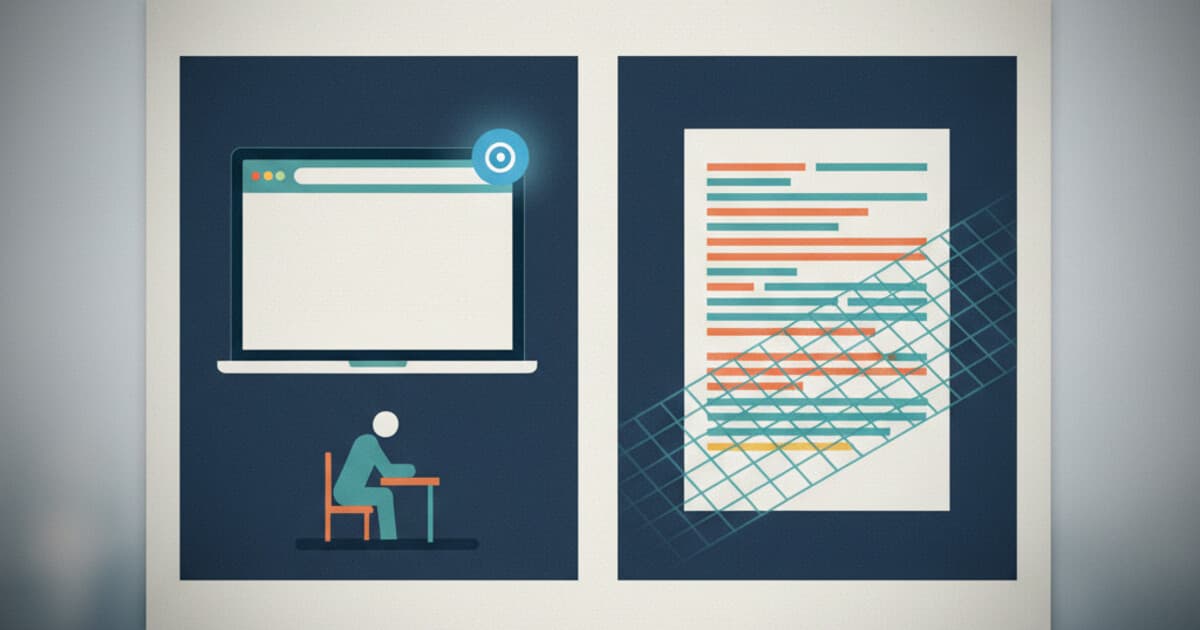
Students using AI tools to write assignments ask about Proctorio constantly. The proctoring software runs on millions of student devices, and there's genuine confusion about what it actually scans. Knowing whether Proctorio detects AI writing tells you exactly where the real risk sits, and where it doesn't.
Proctorio doesn't detect AI-generated writing. It monitors student behavior during online exams through webcam recording and browser lockdown. The tools universities use to catch AI writing, like Turnitin, GPTZero, and Originality.AI, are separate systems that analyze text content. Proctorio and AI writing detection tools serve completely different functions.
What Proctorio Actually Does During an Exam
Proctorio is a remote proctoring platform used by universities to monitor students during online exams. When you start a proctored test, it runs as a Chrome extension that locks your browser, records your webcam and microphone, tracks eye movements, and captures screenshots at intervals. It flags behaviors that suggest cheating: looking away from the screen for extended periods, switching browser tabs, having another person on camera, or opening unauthorized applications.
All of this monitoring happens in real time and gets compiled into a behavior report that instructors review after the exam. Proctorio generates a suspicion score based on flagged behaviors, which instructors can examine alongside the session recordings.
The platform monitors what you do during a test, not the content of what you write. It has no mechanism to analyze text for AI generation patterns. A student could submit a fully AI-generated essay response and Proctorio would flag nothing in the text itself.
Setting up a Proctorio session takes a few minutes before each test. You confirm your identity, complete a room scan, and the browser locks.
Students often find the environment stressful, which can trigger behavioral flags (looking nervous, unexpected eye movements) that aren't actually cheating. Instructors are supposed to weigh context when reviewing flags, but the automated scoring doesn't do that nuance work.
Does Proctorio Detect AI Writing? The Direct Answer
Proctorio can't tell if you wrote something with the help of ChatGPT, Claude, or any other AI model. Its scanning tools focus entirely on behavioral signals: eye movements, browser activity, audio in the room, and camera feed. Analyzing whether prose was produced by a language model requires entirely different technology.
Some students assume any tool running in the background during an exam can see everything about their work. That's not how Proctorio operates. The Chrome extension focuses on the exam environment, not a linguistic analysis of your writing style or vocabulary distribution.
One behavioral overlap is worth knowing: Proctorio can flag copy-paste activity in some configurations. If you paste a large block of AI text into an essay field during a proctored session, that paste action might get flagged.
Proctorio flags the behavior because it suggests pulling from an external source, not because the text is AI-generated. Type your work during proctored sessions and this particular risk goes away.
Some courses use in-exam essay prompts where you type directly into the LMS while Proctorio is running. Those responses go to the instructor after the exam, and instructors can then run them through Turnitin or another AI detector independently.
Proctorio logged that you typed something. The separate detector checks what you actually typed.
How Universities Actually Detect AI Writing
The tools that catch AI-generated text are purpose-built detectors trained to recognize language patterns. Turnitin added AI detection in 2023 and by 2026 covers output from ChatGPT, Claude, Gemini, and other major models. GPTZero and Originality.AI operate as standalone checkers that instructors run independently, often by copying submitted text directly into the tool or through LMS integrations.
These systems analyze several linguistic signals. Understanding how AI detectors work helps clarify the process: AI-generated text tends to have lower perplexity (more predictable word choices), lower burstiness (less sentence-to-sentence variation), and more consistent vocabulary distribution than human writing. Human prose fluctuates with digressions, unusual word choices, and structural variety that AI models produce less naturally.
Accuracy across detectors varies more than the tools admit. Turnitin's AI detection accuracy carries an official false positive rate below 1%, but independent testing shows rates between 2-9% depending on content type and writing style. Students who write in a straightforward, structured style can trigger false positives, which is part of why no university treats a detector flag as automatic proof of cheating.
Proctorio plays no role in this pipeline. It monitors whether you were at your own device in an approved testing environment. Once that session closes, the AI detection question starts.
What Proctorio Can and Can't See
Knowing the exact scope helps clarify actual risk.
Proctorio monitors:
- Your webcam feed, live and recorded
- Room audio through your microphone
- Eye movement patterns during the exam
- Browser activity: tab switching, new windows, leaving the exam page
- On-screen application activity (in screen recording mode)
- Copy-paste actions, if the instructor enabled that setting
Proctorio doesn't detect:
- Whether text was written by AI or a human
- The difference between content you typed and content you pasted (beyond logging the paste action)
- Text composed offline and entered later
- What you accessed on a separate phone or tablet not connected to the monitored session
Instructors configure Proctorio with different strictness levels. A low-stakes quiz might use basic webcam recording only. A high-stakes final might enable full screen recording, advanced eye tracking, and copy-paste flagging.
Students don't always know which level applies, so checking the course syllabus or asking before the exam is worth doing.
The copy-paste flag is the one area where Proctorio's monitoring and AI writing detection come closest to overlapping. Students who pre-write AI text and plan to paste it during a proctored exam face two separate risks: Proctorio flagging the paste behavior, and Turnitin flagging the text content later. Addressing one doesn't address the other.
How NaturalRewrite Can Help
If your concern is a written assignment submitted outside exam settings, the tool that actually matters is whichever AI detector your instructor uses on submitted text. Most universities run essays through Turnitin, which flags content that matches large language model patterns.
NaturalRewrite addresses that problem directly. You paste your AI-generated text, select the tone that fits your context, and the tool rewrites it to read naturally. The Academic tone mode produces formal, scholarly-sounding prose built for essay submissions.
Professional mode works for business writing; Casual handles blog-style content. Once you get the humanized output, NaturalRewrite's built-in AI detection checker lets you verify your score before submitting.
Free accounts handle texts up to 300 words with 5 humanizations per day. Starter ($7/month) raises that to 1,500 words per request, which covers most shorter papers.
Pro ($19/month) handles up to 3,000 words per request for longer essays. Unlimited ($39/month) removes the daily cap for high-volume use. All tiers include the built-in detection checker.
Frequently Asked Questions
Does Proctorio detect AI-generated text?
Proctorio doesn't scan text for AI patterns. It monitors student behavior through webcam recording, browser lockdown, and eye tracking during online exams. AI writing detection is a separate function handled by tools like Turnitin or GPTZero, which instructors run on submitted assignments after the exam. Proctorio has no text analysis capability for detecting AI-generated content.
Can Proctorio tell if I used ChatGPT?
Proctorio can't identify whether you used ChatGPT to write anything. The software monitors your behavior during a proctored session, not the source of what you write. If your instructor suspects AI use, they'd need to run your submitted work through a dedicated AI detector like Turnitin or GPTZero separately from Proctorio.
Does Proctorio flag copy-pasting?
In some Proctorio configurations, instructors enable copy-paste flagging, which logs paste actions as suspicious during an exam. The flag is behavioral, not content-based. Proctorio won't identify pasted text as AI-generated, but a flagged paste can prompt instructor review. Type your answers directly during proctored exams to avoid triggering this flag.
What tools do universities use to detect AI writing?
Turnitin is the most widely used platform, with AI detection built in since 2023. GPTZero, Originality.AI, and Copyleaks are common standalone options that instructors run manually or through LMS integrations. These tools analyze submitted text for linguistic patterns associated with AI generation and operate completely separately from Proctorio.
Is Proctorio accurate at catching cheating?
Proctorio catches behavioral cheating during exams reasonably well, but it generates false flags often. A glance away from the screen, background noise, or a nervous habit can all trigger alerts that instructors then review in context. For AI writing detection specifically, Proctorio contributes nothing. That function belongs entirely to separate text analysis tools like Turnitin.
The Short Version
Proctorio watches how you behave during an exam. The tools that scan your writing for AI patterns, like Turnitin, GPTZero, and Originality.AI, run separately after you submit.
The real risk for AI-written assignments comes from those text-based detectors. If you want to reduce that risk, NaturalRewrite rewrites AI-generated content into natural-sounding prose designed to pass major AI detectors, with a built-in checker so you can verify your score before submitting.