 NaturalRewrite
Does ExamSoft Detect AI Writing? (2026 Guide)
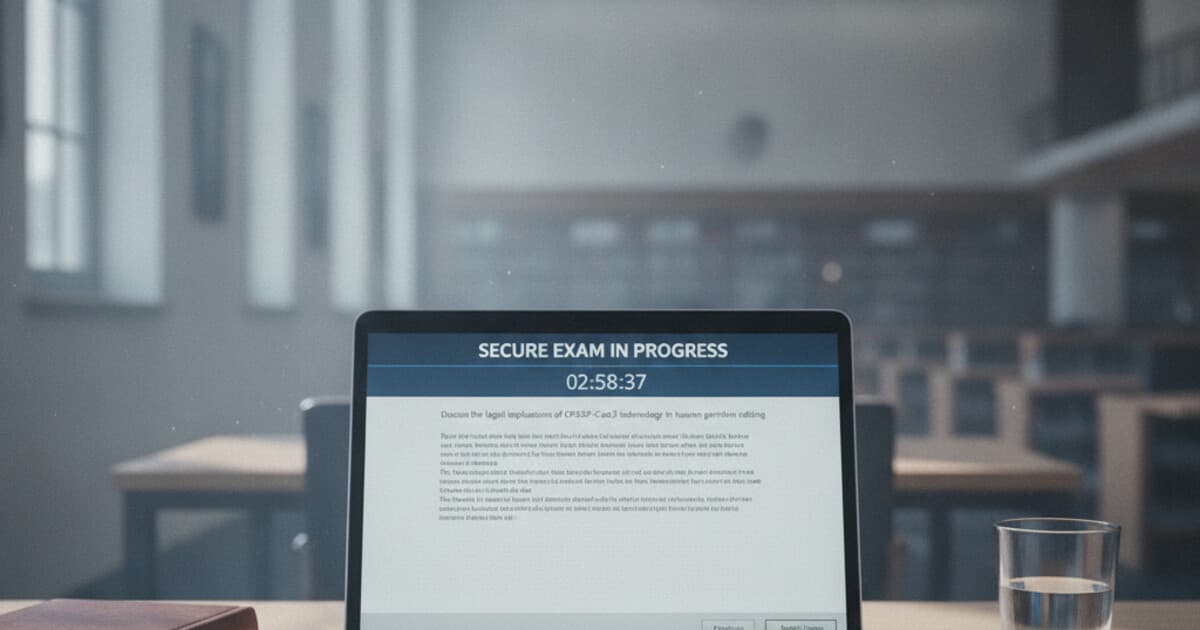
You've downloaded Examplify, set up your exam token, and watched the software lock your screen before a high-stakes final. Medical students, law students, and nursing and dental candidates across professional programs increasingly wonder whether ExamSoft can detect AI writing in their essay responses. Given how much rides on those answers, the question makes sense. ExamSoft is the company behind Examplify, the secure exam platform that professional schools rely on for everything from 1L property finals to clinical licensing prep assessments. Whether it actually scans essay content for AI patterns is a different question from what the software is built to do, and the distinction matters.
ExamSoft's Examplify software doesn't scan essay responses for AI writing. It's a secure exam delivery platform built for behavioral monitoring during the test window: cutting internet access, blocking other applications, and recording webcam footage when institutions configure it. Any AI detection that follows submission is a separate step your school controls using external tools. ExamSoft doesn't do it by default.
What ExamSoft (Examplify) Actually Does
ExamSoft started in 1997 as a secure exam delivery platform for law school testing, originally distributed as SofTest. In 2020, the company relaunched the product as Examplify with a more modern interface, adding webcam recording, audio capture, and keystroke logging to its monitoring feature set. Professional schools across law, medicine, dentistry, nursing, pharmacy, and veterinary programs use the platform for internal assessments. Some state bar exam programs have used Examplify for written portions of their licensing examinations, including performance tests and essay sections. Examplify's security model centers on behavioral monitoring during the exam window: it disables internet access, blocks other applications, prevents window switching, and records webcam footage when institutions configure it. Everything typed during the exam is encrypted locally and uploaded to ExamSoft's servers when the lockdown ends. The platform's infrastructure is built around exam security and behavioral compliance, not AI text analysis or content detection.
When Examplify locks your device, the change is immediate. Your wireless connection drops, your other apps become inaccessible, and every window switch gets flagged in the monitoring log. The exam tracks time spent on each question, records keystroke patterns, and captures webcam footage when set up that way.
That entire workflow is behavioral. Examplify tracks what you do during the exam window: window switches, time per question, webcam footage, keystroke timing. Content analysis of your prose isn't part of what the software produces.
Does ExamSoft Scan Essay Responses for AI Writing?
No. ExamSoft doesn't include a built-in AI writing detector. When your essay responses arrive in your school's ExamSoft dashboard, they land as plain text for graders to annotate and score. The platform's review tools cover rubric assignment, notation, and grade export. Content scanning isn't part of the platform.
Whether your responses get checked for AI writing afterward depends entirely on your institution. Some programs download essay responses and run them through external tools: Turnitin's AI indicator, GPTZero, Originality.ai. Others rely entirely on grader judgment. Check your program's academic integrity policy or ask an administrator directly.
One thing the behavioral log can surface: if administrators notice a response looks unusually polished for a timed exam, they have supporting context from the monitoring data. The log won't tell them whether you used AI, but it can confirm that your internet was cut during the exam and that you didn't exit the secure window. That context typically rules out live AI assistance during the test.
How Schools Review ExamSoft Submissions After the Exam
Post-submission review is where AI detection exposure actually sits for ExamSoft users, and the variability across institutions is wide.
Some programs route written exam responses through an existing plagiarism or AI detection workflow. A law school with a Turnitin license might push downloaded essay responses through Turnitin's AI indicator manually after graders flag a response that seems off. Medical or nursing program administrators might use GPTZero for quick screening of a suspicious submission. These are institution-driven steps, not built-in ExamSoft features.
Graders also assess responses independently. Faculty who've scored the same exam across multiple cohorts notice when a response doesn't fit. An unusually well-structured argument in a 20-minute timed response, vocabulary inconsistent with a student's previous work, or a level of polish that doesn't match the time pressure can prompt a closer look, with or without a detection tool behind it.
If your program does run AI detection on exam responses, how accurate are AI detectors? covers the relevant tradeoffs: Turnitin reports approximately 2% false positives at its default detection threshold, while independent tests put some other tools closer to 15-20%. Scores are treated as one data point, not as proof. An academic integrity proceeding based on AI use typically requires more than a detection percentage alone.
What Exam Lockdown Actually Prevents (and What It Doesn't)
For students worried about AI and ExamSoft, one point often gets overlooked: during the exam itself, Examplify's lockdown makes AI tool access impossible.
When the exam starts, Examplify cuts your internet connection. You can't open a browser tab, reach ChatGPT, access Claude, or use any web-based AI tool while the exam is running. The disconnect is at the network level, not just a browser block. That's the primary AI-prevention mechanism ExamSoft provides, and it works at the point it's designed for: the live exam window.
What the lockdown doesn't cover is how you prepared beforehand. If your program permits certain study materials for open-note exams, AI-assisted notes made before the exam aren't something Examplify can see. Academic integrity policies govern what preparation is allowed, and that's a program-specific question, not a software question.
The lockdown also doesn't apply to take-home assignments or papers submitted outside Examplify. For those, different detection rules apply. How to avoid AI detection as a student covers the broader landscape for written assignments outside of secure exam contexts, including what tools instructors typically use and how detection scores get interpreted.
How to Write Exam Responses That Hold Up
For ExamSoft essay responses written in real time under timed, locked conditions, the dynamics differ from a term paper or take-home.
Timed writing already looks different from AI output. Responses written in 20 or 30 minutes tend to show course corrections, simpler transitions, and uneven pacing between strong and weaker sections. That variation is what makes timed human writing read clearly as human to most detection tools. The smooth structural consistency of AI-generated prose doesn't survive a real-time exam environment, and most detection tools calibrate for that difference.
A few things help keep your responses clearly grounded:
- Write in your own voice rather than a generic formal register. Responses that sound unusually polished for timed conditions draw grader attention even before any tool gets involved.
- Pull in specific material from your coursework. Case names from your syllabus, your professor's framework language, clinical scenario details from your program show familiarity that AI-generated text can't replicate.
- Let your argument develop naturally. AI output tends toward rigid intro-three-points-conclusion structures. Timed exam essays that work through a problem more organically actually read as more authentic.
For take-home assignments outside the ExamSoft context, AI-assisted drafts are a different concern. NaturalRewrite can help you humanize that content and verify it against detection before you submit, which is the appropriate use case here: not the locked exam, but the written work you prepare on your own time.
Frequently Asked Questions
Does ExamSoft's Examplify flag AI writing in exam responses?
Examplify doesn't analyze essay content for AI writing patterns. The software monitors behavior during the exam: internet access, application switching, webcam footage, and keystroke logs. Content review happens after submission when administrators and graders access responses through ExamSoft's dashboard. Any AI detection that follows is a separate, institution-controlled step using external tools like Turnitin or GPTZero.
Can I use AI tools to prepare for an ExamSoft exam?
ExamSoft only monitors what happens during the live exam window. The software has no visibility into how you studied beforehand. Academic integrity policies vary by program and by whether the exam allows external materials. Whether AI-assisted study notes are permitted is a course policy question, not something the software can answer or enforce before the exam starts.
Does ExamSoft work with Turnitin for AI detection?
ExamSoft and Turnitin are separate companies with separate products. Some institutions that license both have connected them manually, routing ExamSoft essay downloads through Turnitin's AI detection as a post-submission step. That connection isn't automatic or universal. Whether your school does this depends entirely on your institution's configuration and your program's academic integrity policies.
What does ExamSoft's lockdown actually block during an exam?
Examplify disables your internet connection, blocks other applications, prevents window switching, and records webcam footage when your institution has that configured. The network-level disconnect makes web-based AI tools like ChatGPT inaccessible while the exam is running. When the exam ends, the lockdown releases and your encrypted response file uploads automatically to ExamSoft's servers.
What happens if a professor suspects AI use on an ExamSoft essay response?
If a grader or administrator suspects AI involvement in an exam response, the typical next step is manual review: comparing the response to the student's previous written work, checking for stylistic inconsistencies, or running the text through an external detector. ExamSoft's monitoring logs, including time-per-question data and exit attempt records, might also be reviewed for context. An academic integrity finding based on AI use usually requires more than a detection score in isolation.
The Bottom Line
ExamSoft (Examplify) doesn't detect AI writing. It's a secure exam delivery platform built for behavioral monitoring, and that's what it does well. The internet lockdown is the AI-prevention mechanism: no internet access means no AI tool access during the exam.
Detection risk, if it exists, sits in the post-submission workflow your institution controls. Check your academic integrity policy to understand what scanning, if any, applies to your program's exam responses.
For take-home assignments and research papers outside the ExamSoft context, NaturalRewrite helps clean up AI-assisted drafts and verify them against detection before submitting. Run your text through Academic tone, check the output with the built-in detection checker, and submit the cleaned version. Start free at naturalrewrite.com.