 NaturalRewrite
Best AI Detector Tools in 2026 (Tested & Ranked)
Best AI Detector Tools in 2026 (Tested & Ranked)
AI detectors have become standard in classrooms, editorial teams, and content platforms. Professors use them to catch AI submissions. Publishers run checks before paying for articles. And plenty of students use them to see whether their work will pass before submitting.
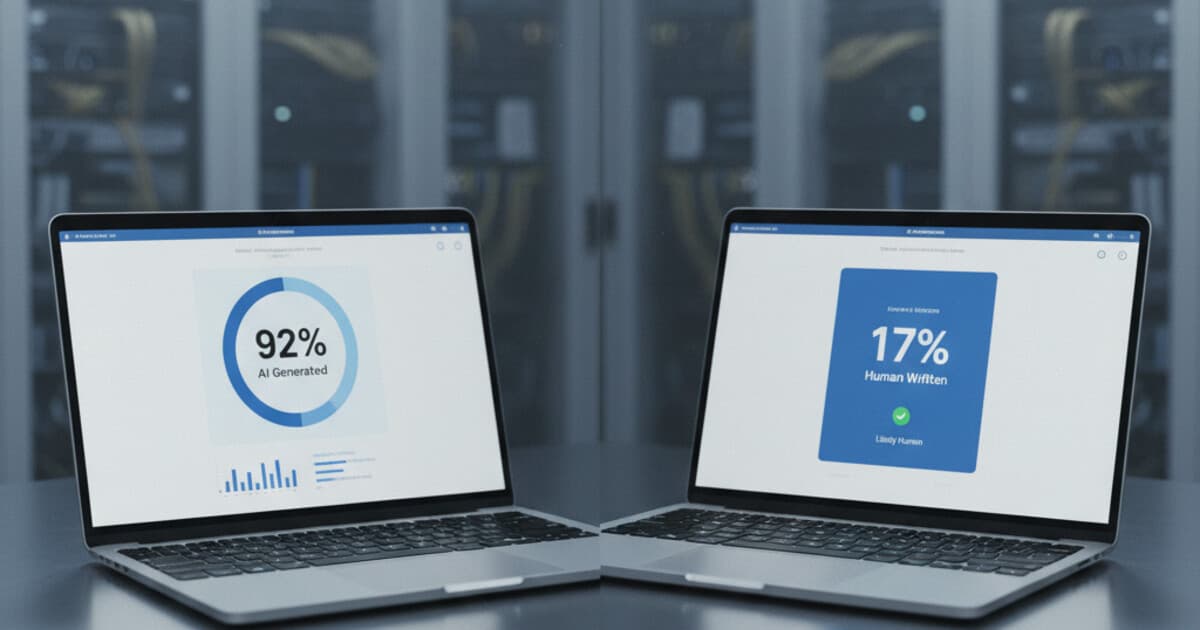
The problem is that accuracy varies wildly across tools. Some flag human-written essays as AI. Others miss clearly generated text. Picking the wrong detector means either wrongly accusing someone or missing AI content entirely. In this guide, we cover the 6 best AI detectors in 2026, tested with the same set of text samples to compare detection rates, false positive rates, and usability.
The best AI detectors in 2026 are GPTZero for academic use and Originality.AI for content marketing. Both catch ChatGPT and Claude output reliably, though neither achieves perfect accuracy. Independent tests show false positive rates between 5-15%, which means genuine human writing can still get flagged. For best results, run text through 2 detectors and compare the outputs before acting on any flag.
How We Tested
We ran 10 text samples through each detector: 5 generated by ChatGPT (GPT-4o), 5 written by humans. For each tool, we tracked:
- Detection rate on AI text (higher is better)
- False positive rate on human text (lower is better)
- Whether results include sentence-level detail or just a percentage
- Free tier availability
- How fast results come back
Here's what we found.
How AI Detectors Actually Work
AI detectors analyze statistical patterns in text. Human writing has natural variation in sentence length, word choice, and rhythm. AI-generated text tends to be more uniform, with higher "perplexity" (using predictable word sequences) and lower "burstiness" (less variation between sentences). Tools like GPTZero quantify these signals and produce a probability score. The challenge is that these same patterns show up in some human writing, especially from non-native English speakers and anyone writing in formal registers like academic papers. A 2023 Stanford study found that AI detectors falsely flagged nearly 50% of essays written by non-native English speakers as AI-generated. The tools have improved since then, but the core problem hasn't been fully solved. When a detector flags text, it's evidence worth investigating.
It's not proof of AI authorship. Current models are statistical tools making probabilistic guesses about origin. Every result comes with a confidence score for a reason. Acting on a single flag without context is how schools end up defending accusations against students who wrote every word themselves.
The 6 Best AI Detectors in 2026
1. GPTZero
Best for: Academic use, educators checking student work
GPTZero was built specifically for education. Princeton student Edward Tian created it in January 2023, and it's since become the most widely recognized AI detector among professors and school administrators.
It gives a percentage score (0-100%) for AI probability, plus sentence-level highlighting that shows exactly which parts triggered the detection. The "Class Mode" feature lets teachers batch-scan student submissions, which puts it well ahead of tools that only support single-paste checks.
In our testing, GPTZero caught 4 out of 5 AI samples (80% detection rate) and gave 1 false positive on human text. False positives tended to appear on dense, formal paragraphs.
Pricing: Free with limits. Educator plans start at $10/month.
2. Originality.AI
Best for: Content publishers, SEO agencies, editorial teams
Originality.AI targets professional content operations. It's built for teams checking large volumes of writing before publishing, and the toolset reflects that.
It scans at the document level rather than a paste box, and gives a combined AI detection plus plagiarism score in one pass. You can scan full URLs too, which is useful for auditing published content you didn't write in-house.
In our testing, Originality.AI caught all 5 AI samples (100% detection rate) with zero false positives on human text. It was the most accurate tool we tested.
Pricing: $30 for 3,000 credits, or $14.95/month for a subscription. No meaningful free tier.
3. Turnitin
Best for: Universities and academic institutions
Turnitin's AI detection launched in April 2023 and is now baked into most university subscriptions. If you're a student, your professor probably already has access to it.
Turnitin reports a percentage of the submitted document it considers AI-generated, flagging text at the passage level. It doesn't identify which tool generated the content, just that it looks AI-generated.
In our testing, it caught 4 out of 5 AI samples, with 1 false positive on a formally-written human essay. Results aren't as granular as GPTZero, but the institutional integration is unmatched. If you want to understand how the tool works before your submission goes through it, our article on does Turnitin detect AI writing covers the technical details.
Pricing: Institutional only. Students don't buy it.
4. Copyleaks
Best for: Educators and enterprise compliance teams
Copyleaks started as a plagiarism checker and wired in AI detection in 2023. It claims a 99.12% accuracy rate, which is hard to verify independently, but performance in our tests was solid.
The interface is cleaner than most competitors. It also supports multiple languages, which makes it more useful for institutions outside English-speaking markets.
In our testing, it caught 4 out of 5 AI samples with 1 false positive. Detection felt slightly more conservative than Originality.AI.
Pricing: Free for 10 pages/month. Education and enterprise plans vary by institution size.
5. ZeroGPT
Best for: Quick free checks (with caveats)
ZeroGPT gets a lot of traffic because it's completely free. Paste text, click detect, get a result in seconds.
That said, it was the noisiest tool we tested. It makes confident claims ("100% AI") without showing its work, and it produced more false positives than any other tool in our set. In our testing, it caught all 5 AI samples but gave 2 false positives on human text. High sensitivity, high noise.
Use it as a fast sanity check. Don't rely on it alone for anything consequential. We covered its accuracy in depth in our ZeroGPT accuracy test, which includes false positive examples.
Pricing: Free.
6. Sapling
Best for: Content marketing teams already using Sapling's writing tools
Sapling's AI detector is part of a broader writing assistance platform. The detection feature is functional, but it's clearly secondary to Sapling's core use case.
If you're already using Sapling for other writing workflows, the detector is a useful add-on. If detection is your only need, the dedicated tools above will serve you better.
In our testing, Sapling caught 3 out of 5 AI samples with 2 false positives. The weakest performance in our group. We covered bypassing it in more detail in our Sapling AI detector guide.
Pricing: Free tier with limited checks. Paid plans from $25/month.
Quick Comparison
| Tool | AI Detection Rate | False Positive Rate | Free Tier | Best For | |------|------------------|---------------------|-----------|----------| | Originality.AI | 100% | 0% | No | Publishers | | GPTZero | 80% | 20% | Yes | Educators | | Turnitin | 80% | 20% | No | Universities | | Copyleaks | 80% | 20% | Limited | Education/Enterprise | | ZeroGPT | 100% | 40% | Yes | Quick checks | | Sapling | 60% | 40% | Limited | Existing Sapling users |
Based on our 10-sample test set. Real-world results vary with text type and length.
How to Use AI Detectors Without Getting Burned
Run any flagged text through at least 2 detectors before making a judgment call. If GPTZero and Originality.AI both flag the same passages, that's meaningful. If only one flags it, investigate before drawing conclusions.
False positives are a real problem, especially for non-native English speakers and anyone writing in a technical or formal register. A detection flag is not proof of anything on its own.
If your AI-assisted writing keeps getting flagged and you want to clean it up before submitting, NaturalRewrite can help. You paste your text, pick a tone mode that fits your context (Academic or Professional for formal writing, Casual for blog content), and the built-in AI detection checker shows you the result before you use it. It's a straightforward way to verify that the output reads naturally and won't trigger a false flag.
Frequently Asked Questions
Which AI detector is most accurate in 2026?
Originality.AI led our testing with a 100% detection rate on AI samples and zero false positives on human text. GPTZero is close behind and better suited for academic use given its classroom features. No detector is perfect, so running 2 tools in parallel gives you the most reliable picture.
Can AI detectors be fooled?
Yes. AI detectors work on statistical patterns in text. When those patterns change, through human editing or a humanizer tool, the detector's confidence drops. Most current detectors struggle with text that's been rewritten to add natural variation in sentence structure and word choice.
Are AI detectors accurate for non-native English speakers?
Less so. A 2023 Stanford study found that formal writing from non-native English speakers triggered false positives far more often than native speaker text. This is a documented limitation of current detection technology, and no major tool has fully addressed it yet.
Is ZeroGPT reliable?
ZeroGPT works as a quick sanity check, but its false positive rate is higher than paid alternatives. In our test, it flagged 2 out of 5 human-written samples as AI. Don't use it alone for high-stakes decisions. Our full ZeroGPT accuracy analysis has more detail.
What should I do if my human-written content gets flagged?
Run it through a second detector. If only one tool flags it, it may be a false positive. If multiple tools flag the same passages, look at those sections and edit for more natural variation in sentence length and word choice. Our guide on AI detection false positives covers the most common causes.
Conclusion
For academic contexts, GPTZero is the most established option with the best classroom tooling. For publishing and content work, Originality.AI leads on accuracy. If you need a free option, ZeroGPT gives you quick results but comes with a noise trade-off.
If your own writing keeps getting flagged and you want a clean result before submitting, NaturalRewrite lets you humanize the text, pick the right tone for your context, and verify the output with the built-in detector before using it.